
Reviewed by Dr. Priya Mehta, Pediatric Health & Child Nutrition Specialist — Updated May 2026
Disclaimer: This article is for general informational purposes only. It is not a substitute for professional advice, diagnosis, or treatment. Always consult a qualified professional before acting on any information in this article.
Only 1 in 4 children worldwide meets recommended physical activity guidelines, according to the World Health Organization — and sedentary behaviour is rising fast. If you’re a parent, teacher, or caregiver wondering what are 10 healthy habits for kids that will genuinely make a difference, you’re not alone. The good news: the habits that matter most are surprisingly simple, and the science behind them is clear. This guide gives you exactly that — evidence-based, practical answers you can start using today.
Why Healthy Habits in Childhood Matter More Than You Think
The habits children form before age 10 shape their physical and mental health trajectories for decades. Research published in the Journal of Pediatrics found that children who maintain healthy lifestyle patterns early in life have significantly lower risks of developing cardiovascular disease, type 2 diabetes, and obesity in adulthood. These aren’t distant risks — they begin taking root in childhood.
The underlying mechanism is neurological as much as physical. A child’s brain is far more plastic than an adult’s, meaning new behaviours are encoded faster and more durably. When a child practises a habit repeatedly — eating breakfast, sleeping on schedule, moving their body — those neural pathways strengthen. What feels like routine to a child becomes a biological default.
Beyond the physical, the WHO’s Global Action Plan on Physical Activity highlights that children with structured healthy habits show measurably better cognitive performance, emotional regulation, and social confidence. A landmark Harvard study tracking children over 20 years confirmed that consistent sleep, movement, and nutrition habits in childhood predicted adult mental health outcomes more reliably than socioeconomic background alone.
Parents often underestimate how much early action matters. You don’t need a perfect plan — you need a consistent one.
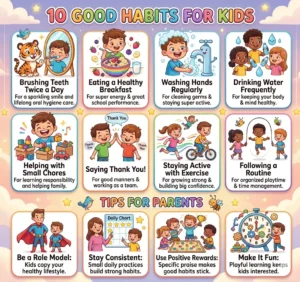
10 Healthy Habits Every Child Should Build
1. Eating Breakfast Every Single Day
Breakfast is the meal children most frequently skip — and the one that most directly affects their school-day performance.
Why it matters: After 8–10 hours of overnight fasting, a child’s blood glucose drops. The brain runs almost exclusively on glucose, so skipping breakfast impairs memory, attention, and problem-solving before the first lesson even starts.
Evidence: A 2019 meta-analysis published in Frontiers in Human Neuroscience reviewed 45 studies and found that children who ate breakfast regularly demonstrated significantly better short-term memory and faster information processing than those who skipped it.
What to do: Aim for a breakfast that includes protein (eggs, Greek yoghurt, nuts), slow-release carbohydrates (oats, wholegrain toast), and fruit. Preparation the night before removes morning friction.
Caution: Not all breakfasts are equal. Sugary cereals spike blood sugar and lead to energy crashes by mid-morning. Prioritise whole foods.
Bottom line: A daily, balanced breakfast is one of the single most impactful habits you can build — it sharpens focus, steadies mood, and fuels the body for active learning.
2. Drinking Enough Water Throughout the Day
Hydration is the habit most parents assume their children manage on their own — but most children don’t.
Why it matters: Even mild dehydration (as little as 1–2% body water loss) measurably reduces a child’s cognitive performance, mood, and energy. Children have higher surface-area-to-body-mass ratios than adults, meaning they dehydrate faster.
Evidence: A study in the American Journal of Clinical Nutrition found that school-age children who drank an extra glass of water per day showed improved attention and visual memory scores compared to a control group.
What to do: Encourage children to carry a reusable water bottle and take sips throughout the day — not just at meals. Aim for approximately 1.5–2 litres daily for school-age children, adjusting for hot weather or physical activity.
Caution: Fruit juices and flavoured drinks do not replace water. They often contain significant added sugar and can displace appetite for nutritious foods.
Bottom line: Clean, plain water — consumed consistently across the day — supports concentration, physical performance, and long-term kidney health more than any supplement.
3. Moving Their Body for at Least 60 Minutes a Day
Physical activity is not optional for healthy child development — it’s a biological requirement.
Why it matters: Movement builds cardiovascular health, bone density, and muscle coordination. It also triggers the release of BDNF (brain-derived neurotrophic factor), a protein that promotes the growth of new brain cells and is directly linked to learning and memory retention.
Evidence: The WHO recommends children aged 5–17 engage in at least 60 minutes of moderate-to-vigorous physical activity daily. Research in The Lancet confirms that children who meet this threshold have lower rates of childhood obesity, depression, and anxiety.
What to do: Activity doesn’t have to mean organised sport. Cycling, dancing, swimming, playground time, or even active household chores all count. The key is consistency, not intensity.
Caution: Competitive pressure in organised sport can backfire for some children, reducing intrinsic motivation to move. Keep activity fun, varied, and voluntary where possible.
Bottom line: Daily movement — in any form the child enjoys — is foundational to physical health, mental sharpness, and emotional resilience.
4. Getting Consistent, Quality Sleep
Sleep is where growth happens — quite literally.
Why it matters: Human growth hormone is primarily secreted during deep sleep. Beyond physical growth, sleep is when the brain consolidates memories, processes emotions, and clears metabolic waste. Chronically sleep-deprived children show impaired decision-making, increased risk of anxiety, and reduced immune function.
Evidence: The American Academy of Pediatrics recommends 9–12 hours of sleep per night for children aged 6–12, and 8–10 hours for teenagers. Research in the journal Sleep found that children with irregular sleep schedules had higher rates of behavioural problems and lower academic performance than those with consistent bedtime routines.
What to do: Set a fixed bedtime and wake time — even on weekends. Remove screens from bedrooms. A wind-down routine (reading, bath, calm talk) signals the brain to prepare for sleep.
Caution: Melatonin supplements should only be used under medical supervision for children. Most sleep issues resolve with environmental and routine changes.
Bottom line: Consistent, sufficient sleep is non-negotiable for healthy development — it affects everything from immunity to emotional regulation to academic achievement.
5. Eating More Fruits and Vegetables Daily
Five servings of fruits and vegetables per day is the recommendation. Most children get fewer than two.
Why it matters: Fruits and vegetables deliver fibre, vitamins, minerals, and antioxidants that support immune function, gut health, and disease prevention. Fibre specifically feeds beneficial gut bacteria, which emerging research links to mood regulation and reduced anxiety in children.
Evidence: A study published in BMJ Open tracking over 7,000 school-age children found that those who consumed five or more servings of fruits and vegetables daily had significantly better emotional wellbeing scores than those who consumed fewer than three.
What to do: Add vegetables to sauces, soups, and smoothies. Make fruit visible and accessible. Involve children in food preparation — children are more likely to eat foods they helped make.
Caution: Forcing children to eat specific foods often creates negative associations. Offer variety repeatedly without pressure; repeated exposure increases acceptance over time.
Bottom line: The habit of eating varied, colourful produce daily pays dividends in immunity, gut health, mood, and long-term disease prevention.
6. Limiting Screen Time and Prioritising Offline Activities
Screens are not the enemy — unregulated screen time is.
Why it matters: Excessive screen time displaces physical activity, disrupts sleep (especially blue light exposure before bed), and limits the face-to-face social interaction children need to develop emotional intelligence and communication skills.
Evidence: The Canadian Paediatric Society recommends no more than 2 hours of recreational screen time per day for children over 5. Research published in JAMA Pediatrics found that children exceeding this threshold showed higher rates of attention difficulties and lower reading comprehension scores.
What to do: Use screen-free times — particularly 1 hour before bed and during family meals. Designate tech-free zones in the home. Replace screen time with reading, creative play, or outdoor exploration.
Caution: All screen content is not equal. Educational and interactive content has different effects than passive entertainment. Quality matters as much as quantity.
Bottom line: Structured screen limits — paired with rich offline alternatives — protect attention, sleep, and social development without demonising technology.
7. Washing Hands Regularly and Practising Basic Hygiene
This habit sounds elementary — yet it remains one of the most effective public health interventions known.
Why it matters: Proper handwashing removes pathogens that cause colds, flu, gastroenteritis, and other illnesses. Children touch their faces an average of 23 times per hour, making hand hygiene a direct line of defence against infection.
Evidence: The CDC estimates that handwashing with soap could prevent about 30% of diarrhoea-related illnesses and approximately 20% of respiratory infections. In school settings, children who wash hands regularly miss fewer school days due to illness.
What to do: Teach the 20-second technique with soap and water. Build handwashing into automatic trigger points — before eating, after the toilet, after outdoor play, and after coughing or sneezing.
Caution: Over-reliance on antibacterial sanitisers can reduce microbiome diversity. Plain soap and water remains the gold standard for children.
Bottom line: Regular handwashing is arguably the highest-return hygiene habit — it’s free, simple, and prevents a remarkable proportion of common childhood illnesses.
8. Reading or Learning Something New Every Day
Cognitive stimulation is to the brain what exercise is to the body — necessary, cumulative, and transformative.
Why it matters: Daily reading builds vocabulary, comprehension, attention span, and empathy. Learning new skills — an instrument, a language, a craft — stimulates neuroplasticity and builds confidence. Children who read for pleasure consistently outperform peers on standardised assessments across all subjects, not just literacy.
Evidence: A landmark Oxford University study following 17,000 children found that reading for pleasure at age 10 was the single strongest predictor of progress in maths, vocabulary, and spelling at age 16 — more predictive than socioeconomic background.
What to do: Create a daily reading window — even 15–20 minutes. Let children choose their own reading material, including comics, magazines, and non-fiction. Read aloud with younger children to model fluency and love of story.
Caution: Reading as a punishment or obligation backfires. Choice and autonomy are key to building an intrinsic reading habit.
Bottom line: Daily reading — chosen freely, not forced — is one of the highest-leverage habits for cognitive, emotional, and academic development across childhood.
9. Spending Time Outdoors in Natural Light
Children today spend less time outdoors than any previous generation — and their bodies are paying the price.
Why it matters: Natural light regulates circadian rhythm, supports vitamin D synthesis (critical for bone development and immune function), and reduces cortisol levels. Time in nature specifically reduces stress markers and improves mood in children. Outdoor play also develops spatial awareness, risk assessment, and resilience.
Evidence: Research published in Pediatrics found that children who spent at least 60 minutes outdoors per day had significantly lower rates of myopia (short-sightedness), a condition reaching epidemic proportions globally. Outdoor light exposure directly stimulates the dopamine release that prevents the eye’s elongation associated with myopia.
What to do: Build outdoor time into the daily schedule — after school, before dinner, on weekends. Nature walks, gardening, or unstructured outdoor play all count. Even sitting outside in natural light has measurable benefits.
Caution: Protect children from excessive UV exposure with appropriate sun protection. The benefits of outdoor time do not require or endorse unprotected sun exposure.
Bottom line: Daily outdoor time — even brief — protects eyesight, regulates sleep, builds vitamin D levels, and reduces stress in ways no indoor activity can fully replicate.
10. Expressing Emotions and Talking About Feelings
Emotional literacy is a skill — and like all skills, it must be practised.
Why it matters: Children who can name, understand, and express their emotions make better decisions, resolve conflicts more effectively, and show greater resilience in the face of adversity. Suppressed or poorly understood emotions in childhood are strongly associated with anxiety, depression, and social difficulties in adolescence.
Evidence: Research from Yale University’s Centre for Emotional Intelligence found that children taught to identify and label their emotions showed a 40% reduction in behavioural issues and a significant improvement in academic engagement compared to control groups.
What to do: Create daily check-in moments — at dinner, at bedtime, during car rides. Ask open questions: “What was the best part of your day? The hardest?” Validate emotions without rushing to fix them. Model your own emotional honesty as a parent.
Caution: Avoid dismissing difficult emotions (“you’re fine, don’t be upset”). Dismissal teaches children that their internal world is not safe to share — the opposite of emotional literacy.
Bottom line: Teaching children to name and express their feelings builds the emotional intelligence that underlies healthy relationships, mental wellbeing, and lifelong resilience.
Key Takeaway: The three habits with the broadest, most documented impact on child health are: consistent sleep (9–12 hours for school-age children), daily physical activity (60 minutes minimum), and regular emotional expression with a trusted adult. Start with these three before adding others. Consistency beats perfection — one habit done daily outperforms ten habits done occasionally.
How to Get Started: A Simple Framework for Parents
You don’t need to overhaul your child’s routine overnight. Attempting too many changes at once usually leads to resistance from children and burnout for parents.
Start with the “anchor habits” first. Sleep and movement are the two habits that make every other habit easier. Prioritise a consistent bedtime and 60 minutes of daily activity before addressing nutrition or screen time.
Use habit stacking. Attach new habits to existing routines. Handwashing already happens near the bathroom — add it to “before every meal.” Fruit can become “always eaten at breakfast.” Reading happens “every night for 15 minutes before the light goes off.” The existing routine acts as the trigger.
Involve children in the decision. Children are far more likely to adopt habits they helped choose. Present two healthy options rather than issuing instructions: “Would you rather have an apple or a banana with lunch?” Autonomy within boundaries builds cooperation.
Track progress visibly. A simple wall chart where children tick off daily habits builds pride and accountability without pressure. Focus on streaks, not perfection — a missed day is never the end.
When to seek professional support: If your child consistently struggles with sleep, refuses to eat, or shows signs of emotional withdrawal, consult a paediatrician or child psychologist. These habits are powerful supports — not replacements for clinical care.
Common Mistakes to Avoid When Building Kids’ Healthy Habits
Mistake 1 — Trying to change everything at once. Introducing five new habits in a week overwhelms children and parents equally. Pick one habit, build it for three weeks, then add another. Slow is sustainable.
Mistake 2 — Using food as reward or punishment. Saying “eat your vegetables or no dessert” teaches children to see vegetables as an obstacle and dessert as the prize — the opposite of the association you want. Offer both foods neutrally.
Mistake 3 — Ignoring your own habits. Children copy what they see, not what they’re told. A parent who sits on their phone through dinner while telling children to limit screen time creates confusion, not compliance. Model the habits you want.
Mistake 4 — Making exercise feel like punishment. “You need to go outside” feels different from “let’s kick a ball around before dinner.” Language and framing shape children’s emotional relationship with movement for years.
Mistake 5 — Skipping emotional habit-building. Physical health habits get most of the attention, but emotional literacy and daily connection are equally foundational. Don’t let the focus on food and sleep crowd out time for real conversation.
Frequently Asked Questions
Q1: What exactly are healthy habits for kids, and how are they different from adult health habits?
Healthy habits for kids are consistent daily behaviours that support a child’s physical growth, cognitive development, and emotional wellbeing. While many overlap with adult health habits — sleep, movement, nutrition — children have specific needs. They require more sleep (9–12 hours vs. 7–9 for adults), need daily outdoor play for normal sensory and motor development, and benefit uniquely from emotional modelling by trusted adults. The habits that stick longest are those built early, practised consistently, and linked to positive experiences rather than obligation.
Q2: Are these healthy habits safe for children of all ages, or do they need to be adapted?
Yes, these habits apply broadly — but age-appropriate adaptations matter. Toddlers need 11–14 hours of sleep; teenagers need 8–10. Physical activity for young children should be unstructured play rather than structured exercise. Emotional literacy conversations should be simplified for younger children (“what colour is your feeling today?”) and more nuanced for older ones. When in doubt about a child’s specific needs — particularly around nutrition or sleep — consult a paediatrician rather than applying adult guidelines to children.
Q3: How long does it take for a child to form a lasting healthy habit?
Research suggests new habits require anywhere from 21 to 66 days of consistent practice to become automatic — with children typically forming habits faster than adults due to greater neuroplasticity. A realistic target for most parents is four to six weeks of daily repetition before a habit feels natural. The key variable is consistency, not duration of each instance. Five minutes of daily reading every night solidifies faster than 30 minutes twice a week.
Q4: What is the biggest mistake parents make when trying to build healthy habits in children?
The most common and damaging mistake is using coercion — forcing children to eat, sleep, or exercise through threats or punishment. Coercion can make children comply short-term while building deep negative associations that outlast childhood. The evidence consistently shows that habits built through autonomy, choice, and positive reinforcement stick far longer. Offering two healthy options rather than one mandate, celebrating effort rather than results, and modelling the habit yourself will generate more durable change than any rule.
Q5: Which children should approach these habits with extra care or professional guidance?
Children with chronic health conditions (asthma, diabetes, food allergies), sensory processing differences, eating difficulties, or diagnosed mental health conditions should have their habits tailored by a healthcare professional. Children who are significantly underweight or overweight should not be put on restrictive diets without medical supervision. If a child shows persistent sleep disturbances, extreme food restriction or refusal, or significant mood changes, these warrant professional assessment rather than self-guided habit-building alone.
Final Thoughts
Every parent wants their child to thrive — and the path there is less complicated than the wellness industry suggests. What are 10 healthy habits for kids? They are the basics, done consistently: eat well, move daily, sleep enough, drink water, go outside, limit screens, wash hands, read, talk about feelings, and repeat. None of these habits require expensive equipment, specialised programmes, or perfect execution. They require showing up, day after day, with patience and presence.
The research is unambiguous: the earlier these habits are established, the more powerful and lasting their effects. But “early” doesn’t mean you’ve missed your chance if you’re starting today. The brain remains adaptable throughout childhood, and even adolescence.
Bookmark this article, share it with someone raising children alongside you, and start with just one habit this week. One consistent change is worth infinitely more than ten ideas left unacted upon.
Your children don’t need a perfect childhood. They need a healthy one — and you already have everything it takes to give them that.
Disclaimer: This article is for general informational purposes only. It is not a substitute for professional advice, diagnosis, or treatment. Always consult a qualified professional before acting on any information in this article.
